
Our Story
Flat Roofing Is the Whole Job Here, Not a Sideline
Brooklyn's commercial and residential flat-roof specialists - EPDM, TPO, and modified bitumen.
Home > Our Story
Our Story
We Build Our Whole Year Around Flat Roofs
A flat roof works against gravity in a way a pitched one never has to. Rain doesn't drain off on its own; it has to be pushed toward the drains by a slight built-in slope, and anywhere that slope is wrong, water sits and waits for a weak seam. Get the membrane, the seams, and the drainage right and the roof runs for decades. Get any one of them wrong and it leaks within a season.
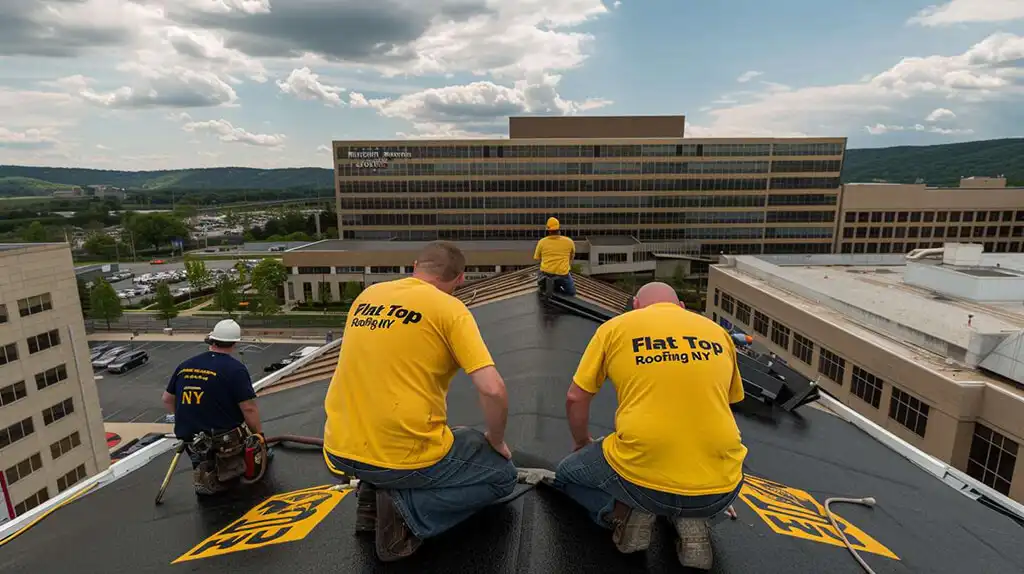
That's the work FlatTop does, and the only work we do. EPDM, TPO, and modified bitumen across Brooklyn - installed new, repaired, recoated, or torn off and rebuilt when there's nothing left to save. Sticking to one category of roof means we've watched how each membrane behaves over years of New York weather: how TPO seams take constant foot traffic, where EPDM shrinks and pulls at the corners, how a mod-bit cap handles the freeze-thaw swing from January to March.
The buildings here keep us specific. Warehouses with acres of single-ply over steel deck. Restaurants where grease exhaust slowly bakes the membrane around the hood curbs. Apartment and office buildings carrying rooftop units, conduit, and service crews walking the surface every week. Each one fails in its own way, and recognizing the pattern early is the difference between a repair that lasts and one that opens back up by spring.
What We Put Down, Patch, and Keep Alive
Three Things We Don't Negotiate On
The wide-open field of a membrane rarely springs the first leak. It's the transitions - where the roof meets a wall, a drain, a vent, or a skylight curb - that move, crack, and let water through. We hand-detail those points and check them on every visit, because that's where the money quietly runs out.
A membrane caught while it's still sound can take a silicone or acrylic coating that adds ten or fifteen years for a fraction of a tear-off. Wait until it's saturated and there's nothing underneath worth keeping - at that point you're paying for the full system regardless. We'll tell you straight which of the two you're actually looking at.
Manufacturer coverage on EPDM and TPO only stays valid when the system goes down to spec: correct fasteners, properly welded seams, certified detailing at every penetration. We install to those standards so the paperwork behind your roof is worth something the day you need to use it.
Why Brooklyn Building Owners Stick With a Specialist
Brooklyn's flat roofs get used hard: restaurant exhaust cooking the surface, warehouse decks walked daily by service crews, apartment and office roofs loaded with HVAC, conduit, and constant traffic. We design and repair around how the roof is actually lived on, not around a clean drawing. If yours is leaking or simply overdue for a look, a free estimate tells you whether you're facing a patch, a coating, or a replacement before you spend a dollar.
Flat roofs are all we touch. A general roofer fits low-slope work in between shingle jobs and treats single-ply like a smaller version of something it isn't. Our crews weld TPO seams and torch mod-bit caps every week of the year, and the repetition is the whole advantage.
We're licensed and insured in New York and certified on the membrane systems we install - which means a real manufacturer warranty, not a handshake, stands behind the work.